Expose app-native async tools
Return a KDCubeMCPServer from an app's @mcp surface. MCP tools call the same async domain services the app can expose through API, jobs, chat, or widgets.
KDCube apps can expose async tool services and connect MCP services to hosted agents. App MCP endpoints support the July 28 discovery and per-request wire path through the official Python SDK v2 while retaining legacy initialization for older clients. Around that wire, KDCube adds per-agent inventories, delegated OAuth, connected accounts, operation-level grants, live revocation, server-side credentials, files, economics, and distributed app serving.
Modern discovery, self-contained requests, routing headers, result envelopes, and cache hints.
Automatic modern discovery with fallback to the retained 2025-era handshake.
Optional extensions and untested base patterns are kept outside the public claim.
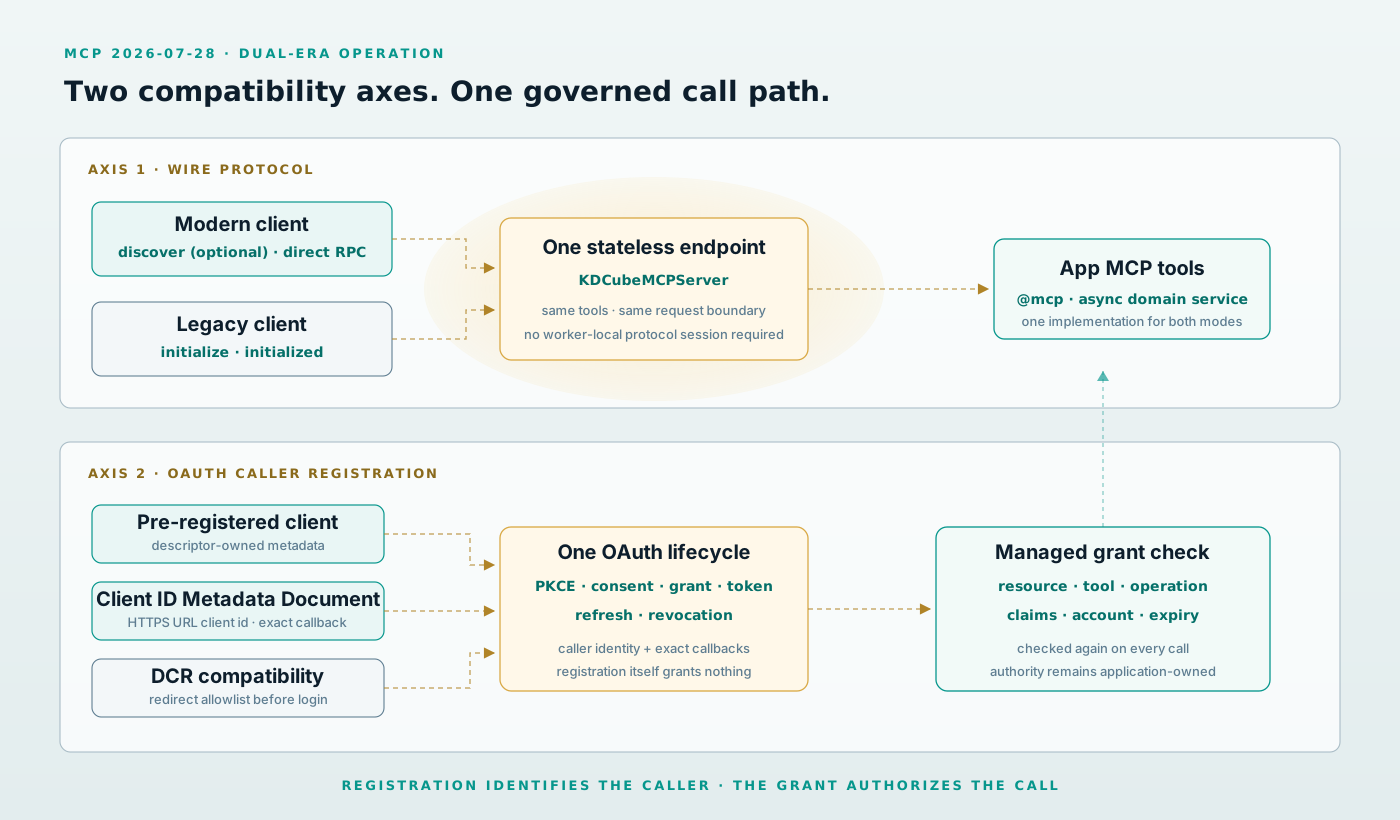
The regression crosses the same KDCubeMCPServer and proc bridge used by app MCP endpoints. It records the actual modern exchange and the retained legacy negotiation path.
| Contract | KDCube behavior | Evidence |
|---|---|---|
| Discovery | server/discover is the modern capability and version entry point. No modern initialize handshake is required. |
Wire test ↗ |
| Per-request metadata | Each modern request carries the protocol version and client capabilities in _meta; KDCube clients also send client information. |
Base protocol ↗ |
| HTTP routing | MCP-Protocol-Version, Mcp-Method, and operation-specific Mcp-Name travel with the request and agree with its body. |
Support boundary ↗ |
| Sessionless dispatch | Modern requests carry no Mcp-Session-Id. Proc workers dispatch requests independently instead of recovering a bundle-local protocol session. |
MCP runtime guide ↗ |
| Results and caching | Ordinary modern results use resultType: complete and server identity metadata. Cacheable lists carry ttlMs and cacheScope. |
Specification ↗ |
| Dual-era client | KDCube consumers use automatic modern discovery and fall back to legacy initialize for older peers. Known legacy endpoints can be pinned explicitly. |
Consumer configuration ↗ |
The common wire is one part of the product. KDCube lets an app provide MCP, consume it for one or many agents, govern the authority crossing each endpoint, and operate the resulting service with the same app lifecycle as every other surface.
Return a KDCubeMCPServer from an app's @mcp surface. MCP tools call the same async domain services the app can expose through API, jobs, chat, or widgets.
Consumer configuration supports stdio, HTTP and Streamable HTTP, and SSE. Named secret references are resolved on the trusted side rather than copied into agent configuration.
Several agents can share one server while receiving different allow-lists. Strategy traits can guide how the resident ReAct harness plans and combines those tools.
An app may consume remote MCP without exposing a server, expose its own tools without consuming another server, or compose both directions in one application.
Modern clients use stateless discovery and self-contained calls. Automatic fallback keeps older initialize clients on the same app tools during migration.
Declare a deliberately public surface, let the app own authentication, or use Connection Hub managed authorization. Route visibility and authority remain separate choices.
Use descriptor pre-registration, HTTPS Client ID Metadata Documents, or configurable DCR compatibility. Registration establishes caller identity and callbacks; it grants nothing.
A managed grant binds the approving user, caller, concrete resource, tools and operations, claims, selected accounts, identity scope, expiry, and revocation state.
Each managed call resolves the current grant and selected operation. OAuth codes, consent state, and refresh rotation use atomic single-consumer transitions, so revocation and narrowing win.
The caller holds a scoped KDCube bearer, never the user's Gmail, Sheets, or Slack token. The connected-account broker resolves the provider credential only after both consent gates pass.
OAuth consent uses short-lived, user-bound, single-use CSRF proof. Apps can opt selected cookie-authenticated operation POSTs into the same one-time request-proof pattern.
A hosted agent can request consent in chat, an external MCP client can complete OAuth, and an operator can issue bounded automation access. All stay inside the same resource ceiling.
The runtime projects the external actor, approving grantor, product-data subject, economics subject, grants, and selected operations into request context.
Tools can return structured results, pagination, stable object refs, and short-lived download URLs. Resident ReAct tools can also declare files for conversation artifact hosting.
Optional named services turn broad provider APIs into stable namespaces, progressive schemas, search/get/upsert/action operators, object refs, and downloadable artifacts without a flat catalog of hundreds of tools.
An app can opt its service into accounting, spend admission, reservation, settlement, and rate policy under the projected economics subject. These controls are configured by the app, not implied by MCP.
Stateless requests can land on any proc worker. Product state lives in shared application storage, so scaling the runtime does not require sticky MCP sessions.
The MCP surface travels with the app's Git version, descriptor, interface, and tests. Saving a new version or effective props reloads it through the normal app lifecycle.
Managed denials identify the missing resource, tool, claim, account, or consent action. Runtime logs carry non-secret transport, endpoint, tool, run, and final-status evidence.
A KDCube MCP endpoint can be public, app-owned, or protected by the platform-managed delegated credential path. Managed access keeps caller registration, user consent, current grants, provider credentials, and operation execution as distinct decisions.
HTTPS Client ID Metadata Documents are supported with bounded fetches, address validation, exact client ID and callback matching, and cache controls. Descriptor pre-registration remains available; DCR is a separately configurable compatibility path.
Managed calls and refresh resolve the current Connection Hub grant. Narrowing, expiry, or revocation takes effect on the next boundary crossing rather than trusting an old embedded authority snapshot.
The external agent holds a scoped KDCube bearer, not the user's provider token. Provider credentials are resolved only inside the trusted service path after the delegated grant passes.
The OAuth consent form uses a short-lived, user-bound, single-use CSRF token. Selected cookie-authenticated Connection Hub mutation POSTs also require an app-operation token bound to the subject and exact operation. This protection is explicitly enabled with csrf; it is not imposed on bearer clients or every app POST.
MCP separates a required base protocol from independently negotiated extensions. KDCube publishes the capabilities it has exercised instead of turning one passing path into a blanket certification.
server/discover and per-request Streamable HTTP exchange.server/discover, tools/list, and tools/call. It does not claim the prompts, resources, sampling, elicitation, or logging primitives.requestState are not included in the current public KDCube support statement.browser_id or cart_id remains the app's resource policy; a handle is never authority by itself.Why the wording matters: KDCube is ready for the tested July 28 wire and authorization paths described here. “Conforms to every requirement and extension” is a different statement and will be made only with the corresponding evidence.
The public page is an index. The protocol specification, KDCube canonical docs, implementation tests, and builder recipes remain the sources of depth.
MCP 2026-07-28 specification ↗ defines the stateless base protocol, per-request metadata, message patterns, authorization, and extension boundary.
Delegated credential protocol adapter ↗ owns the modern wire and OAuth support boundary.
MCP v2 wire regression ↗ exercises modern and legacy exchanges through the app server wrapper and proc bridge.
Bundle operation CSRF contract ↗ defines opt-in, single-use request proof for cookie-authenticated operation POSTs and the descriptor override.
Expose an MCP service from an app ↗ and delegate it to an external client ↗.
These articles move from the infrastructure decision to KDCube's two MCP directions, then follow delegated access end to end and finish with the complete builder configuration.
Why inventory, authority, economics, execution, and evidence become the larger operating question around the common wire.
Read article ↗ Engineering mapThe complete provider and consumer map: per-agent inventories, app-native surfaces, named services, delegated authority, and economics.
Read article ↗ Delegated accessFollow a hosted agent, external MCP client, or automation credential through registration, consent, both call-time gates, and credential resolution.
Read article ↗ Builder recipeConfigure the managed door, resource ceiling, delegable capabilities, client registration, namespace boundary, and connected-account gates.
Read recipe ↗Keep the app implementation async and framework-neutral. Let the runtime own transport negotiation, delegated access, rate limits, economics, and scale around it.